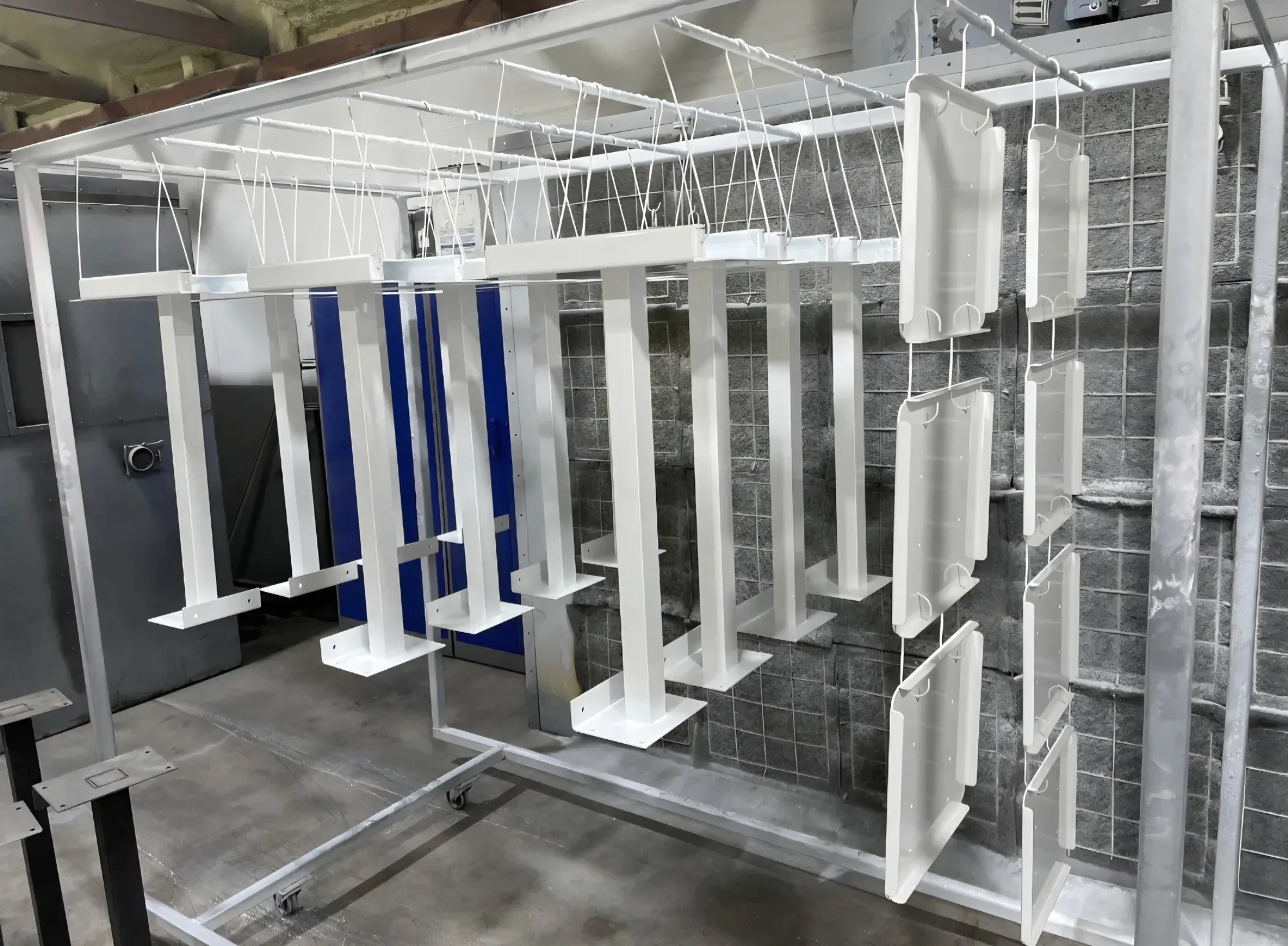
Metal fabrication is the work of turning flat stock into a finished part: cutting the profile, welding the assembly, then finishing it. Unlimited Powder Coating in Hackettstown, New Jersey does all three in one building — laser cutting, welding and powder coating — so a stand, guard or weldment goes from a drawing to a coated part without moving between a fabricator, a welder and a coating shop.
Steps that usually live in different buildings
The normal route for a fabricated part is a laser house, then a welder, then a coating shop. Three
vendors, three lead times, three sets of hands, and nobody who owns the result when the holes do not
line up.
Here it is one sequence in one building: laser cut the profile,
weld the assembly, blast it and
powder coat it. That is the whole reason to fabricate and finish in the
same place — a problem found at the weld stage is a conversation, not a two-week round trip.
Tolerances survive the finish, if you say so
Powder is real film thickness. A coated bore is a scrapped part, and a coated thread is a part that
will not assemble. Threads, bearing bores, sealing faces and any machined surface get masked so they
stay to size, but only when we know they matter.
Mark them on the drawing or on the parts themselves. Where a coated surface has to fit into
something else, the film gets planned for rather than discovered afterwards.
Assemblies, not just parts
The flat components come off the laser; this is what gets built out of them. Stands and frames,
welded assemblies, machine guards and housings, enclosures and equipment covers, railings and gates.
Some of it starts from a proper drawing, some from a sketch, some from the broken assembly that
needs replacing.
For spec-driven or repeat production work — recorded process, controlled prep, protective coatings —
see industrial powder coating.
What to send
The drawing or file, the material and thickness, the quantity, and what the finished assembly has to
do. If it is a repair or a replacement, photos of the old part with a tape measure in frame beat a
description every time.
What do you need to quote a fabricated part?
A drawing or a CAD file is ideal, and DXF is the usual working format for anything being cut. A dimensioned sketch works, and so does the old part if you still have it. Say what material and thickness you want, how many you need, and what the finished assembly has to do — that decides how the parts are laid out before a single cut is made.
Do you fabricate one-off parts, or only production runs?
Both. A single replacement bracket is a normal job here, and so is a repeat run for a shop that needs the same part every quarter. Repeat work gets the material, the cut file, the masking and the finish recorded the first time, so batch fifty comes back looking like batch one.
Can you make a part from a sample instead of a drawing?
Often, yes. Bring the broken part, or what is left of it, and it can be measured and redrawn. Where it gets difficult is a part with features that have worn or bent out of true, because then the sample is no longer the dimension you want. Say what the part mates with and that usually settles it.
What materials do you fabricate in?
Steel, stainless and aluminum are the usual ones, in sheet and plate. Tell us what the part is for as well as what it is made of: material choice interacts with the finish, and a part destined for outdoor service wants different treatment underneath the color than one living in a machine room.
Is the finish included, or do I take the part away bare?
Either. Most customers have the part coated here because it is already in the building and nobody has to schedule a second stop. Some take parts away bare for plating or paint elsewhere. Bare steel starts to flash rust quickly once it is clean, so have a plan for what happens next before you collect it.